







simonashley
On Training Wheels
Extensively Researched — Sourced Southern France — Two Wheelsets
The Model
The PX-10LE was introduced in 1974 as the top production model in the Peugeot range — "Luxe Équipement" (Luxury Equipment), confirmed by BikeBoomPeugeot.com, the most comprehensive Peugeot reference resource. It sat above the standard PX-10E and below only the hand-built PY-10 produced in Peugeot's Atelier Prestige workshop. Eddy Merckx began his professional career on a PX-10. Tommy Simpson rode one in the 1967 Tour de France. Bernard Thévenet won the 1975 and 1977 Tours de France on PX-10 derived machines. Between 1903 and 1983 Peugeot-sponsored riders won the Tour de France ten times.Frame Authentication
Reynolds 531 double-butted tubing throughout — frame, forks, and stays. Confirmed by the original French language "CONSTRUIT AVEC TUBES REYNOLDS" decal without ® symbol. Reynolds 531 was granted registered trademark status in 1975, after which the ® was incorporated into all decals. The absence of the ® confirms pre-1975 manufacture.Nervex Série Légère lugs — the plain smooth lug correct for the 1974 PX-10LE, distinguishing it from the earlier PX-10E which used Nervex Professional. Hand-brazed construction throughout with characteristic scalloped lug profiles.
Simplex chrome dropouts — front and rear. Correct and exclusive to the PX-10 range and above.
Chromed stays and fork blades — defining characteristic of the PX-10 family, distinguishing it from lesser models.
Built at the Beaulieu factory — absence of "RY" Romilly date code on bottom bracket shell is consistent with Beaulieu production of the PX-10LE.
Serial number: 1420252 — riveted tin plate below bottom bracket, consistent with 1970s Beaulieu production.
Colour: Teal/blue — confirmed original factory specification, identical to a known fully restored 1974 PX-10LE reference example (MetalTeamster, YouTube, 2025). Not a repaint.
Size: 23" seat tube (approx. 58cm c-t), 21" top tube reach. Suits rider approximately 6'0"–6'2". Rear spacing 120mm.
Provenance: Purchased in southern France. Dry Mediterranean climate consistent with the remarkable preservation of original components.
Components
Stronglight 93 crankset — correct and original specification for the 1974 PX-10LE. Stronglight invented the cotterless square-taper crankset in 1933. The 93 features the distinctive drilled pentagram spider design. Chainrings approximately 52/42t. Note: one crank bolt is sheared — bolt head missing, crank has remained secure and unmoved for approximately 20 years. Addressable by a competent mechanic if crank removal is ever required.Simplex Criterium rear derailleur and Simplex retrofriction shifters — complete matching Simplex combination. Derailleur identified as Criterium by silver badge with Simplex script and red pivot plugs on upper and lower pivot bolts — distinguishing it from the entry-level Prestige (red badge, no steel reinforcement). Simplex and Peugeot had an extraordinarily close working relationship — both based in the same region of France. Thévenet won both his Tours on Simplex-equipped Peugeots. The Simplex retrofriction shifters were considered superior to Campagnolo shifters by many professional riders of the era and remain sought after by collectors.
Mafac Competition brakes — complete matching set, front and rear. Mafac's slogan "Un doigt suffit" (one finger is enough) captured their revolutionary achievement. The Competition differed from the Racer in three specific ways: brass rather than plastic pivot bushings, shorter reach specifically designed for tubular-wheeled racing bikes, and double ball-ended straddle cable. Introduced around 1970, the Competition was more expensive than the Racer and the correct brake for the PX-10LE. Peugeot was virtually the last professional team using Mafac — Thévenet rode gold anodised Mafac Competition at the 1974 World Championship in Montreal and on both Tour de France victories. Half-hooded levers correct for 1974 specification — the fully drilled "holey" levers came in 1975. Original black cartouche with gold "COMPETITION MAFAC" badge intact on both calipers. "Made in France" stamped on reverse.
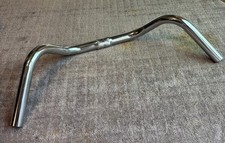
Atax Philippe "Course Forgée" bars and stem — introduced specifically on the 1974 PX-10LE, making this a precise model year identifier. Recessed allen-key expander bolt confirmed — distinguishing it from the earlier slotted bolt stem. Philippe was considered on a quality par with Cinelli and 3TTT. Note 7mm allen key sizing — unusual, handle with care. Team bikes used Cinelli; Philippe confirms top production rather than team specification.
Maillard 700 pedals — chrome rat trap cage with red background Maillard logo on spindle end cap. The red logo confirms pre-1980 genuine French Maillard production — after the Sachs acquisition in 1980 the branding changed. Complete with original toe clips and leather toe straps with functioning buckles. Toe clip attachment plate present on pedal body.
Ideale 2002 leather saddle — confirmed original factory specification for the 1974 PX-10LE by comparison with a known fully restored reference example of this exact model. Earlier secondary sources suggested the 2002 was reserved for the PY-10; the reference example confirms the 2002 was standard fitment on the 1974 PX-10LE. Thévenet won both his Tours on Ideale saddles. Ideale factory closed 1984 — saddle appears original to the bicycle.
Tubular Wheelset — Exhibition/Original
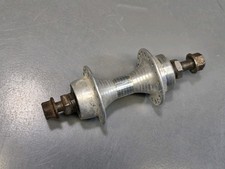
A purpose-built competition wheelset of exceptional quality, intact after 50 years.Maillard 700 "Professional Team Peugeot Trophy" high-flange hubs — the correct factory specification for the PX-10LE from the mid-1970s, replacing the earlier Normandy Luxe Competition. High-flange diameter approximately 75mm. 36h. Maillard/Normandy/Peugeot Trophy are the same hub family, badged differently for different markets and fitments.
Super Champion Competition 700c tubular rims — approximately 364g each. Super Champion was one of France's most prestigious rim manufacturers. The Competition sat mid-range — above the Etoile, below the Médaille d'Or. Race-proven and correct for a competition specification bicycle of this era.
Robergel Sport spokes — crescent moon head marking confirmed. Robergel of Perruel, Normandy were France's finest spoke maker, used by René Herse and Alex Singer from the 1940s. The crescent moon identifies these as the Sport model — 15×17 double butted gauge (1.8mm ends tapering to 1.5mm centre), zinc-plated carbon steel. Considered the stronger of the two Robergel lines for racing use. Packaging claimed "pratiquement incassable" (practically unbreakable). Crescent moon marking clearly visible and photographed.
Tied and soldered at all spoke crossings with copper wire — the premium competition wheelbuilding technique of the era. Applied to add lateral stiffness, prevent spoke wind-up under braking, and compensate for the fine 15×17 gauge. Not applied to ordinary wheels. Copper wire clearly visible at crossings.
No tyres fitted. Shimano 6-speed freewheel fitted (non-original — correct would be 5-speed Maillard or Simplex). Simplex quick release skewers. Weights:850g & 1832g (front & Back)
Clincher Wheelset — Fitted, Ride-Ready
A period-correct spare wheelset built March 1981 — documented by date stamp on hubs. Represents the classic two-wheelset ownership pattern: tubulars kept for best, practical clinchers built for everyday riding.Normandy wide-flange hubs — date stamped 23–29 March 1981. Normandy was Maillard's export brand — the same hub family as the Peugeot Trophy units on the tubular wheelset. Normandy consistently date-stamped their hubs, providing unusually precise documentation.
Mavic Module D Argent 700c clincher rims — earlier and more period-correct than the Module E. Mavic, Lyon.
Simplex Racing 5-speed freewheel with precision bearings — correct original specification for the PX-10LE.
Simplex quick release skewers. Clincher tyres fitted — ride-ready.
Dating Evidence Summary
| Evidence | Implication |
|---|---|
| Reynolds 531 decal — French text, no ® | Pre-1975 manufacture |
| Serial number 1420252 — 7 digits | 1970s production |
| Atax Philippe Course Forgée stem | First used on 1974 PX-10LE specifically |
| Plain Nervex Série Légère lugs | Correct for 1972–1974 PX-10LE |
| Maillard 700 high-flange hubs | Mid-1970s specification |
| Ideale 2002 saddle — introduced 1973 | 1973 or later |
| Normandy hub stamp — March 1981 | Second wheelset built 7 years after frame |
| Maillard 700 red logo pedals | Pre-1980 French Maillard production |
| Super Champion Competition rims | 1970s production |
| Robergel Sport crescent spokes | 1960s–1970s production |
Non-Original Items
- Shimano 6-speed freewheel on tubular wheelset (original would be 5-speed Maillard or Simplex)
- Everything else original and correct
Condition
Fair to good. Original colour confirmed — teal/blue is the correct factory specification, not a repaint, identical to a known fully restored 1974 PX-10LE reference example. Jockey wheels recently replaced — shifts correctly through all gears. One sheared crank bolt as noted. Brake pads hardened with age — functional but will benefit from replacement. Original chrome presentable. Both wheelsets complete and functional. Tied and soldered tubular wheelset construction confirmed as original factory specification by reference example. I have the original rat traps with good leather strapsAsking Price
CAD $1,100 — firm, reflecting top-of-range 1974 PX-10LE specification, largely original correct components throughout, two complete period-correct wheelsets including a tied-and-soldered tubular set with documented Robergel Sport spokes, and comprehensive researched provenance.Cash or e-transfer. Collection preferred, Toronto. Shipping possible at buyer's expense and risk.
Full component documentation available to serious buyers.
All identifications cross-referenced against Classic Rendezvous PX-10 history, Classic Factory Lightweights 1974 PY-10 and 1975 PX-10 specifications, BikeBoom Peugeot serial numbers, Disraeli Gears derailleur history, South Salem Cycleworks, Robergel spoke documentation, and specialist vintage cycling forums. Colour, saddle specification and wheelset construction confirmed by MetalTeamster "1974 Peugeot PX-10" YouTube (2025) — a fully restored example of this exact model.


