


When you click on links to various merchants on this site and make a purchase, this can result in this site earning a commission. Affiliate programs and affiliations include, but are not limited to, the eBay Partner Network.

The Death Stem?

#eBayPartner    Most Recent BUY IT NOW Items Listed on eBay
eBay Auction Picture
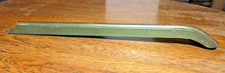
My only reservation to repairing one of these stems in this manner, is making sure that there is enough length left for proper insertion into the forks steer tube.
The admonition in that article about not tightening the expander wedge into the threaded portion of the steer tube, should most definitely be heeded.
The repair to the stem in the picture above, is way too short to be able to accomplish this very important safety issue.
Just sayin.
 
Cool article, 👍👍 I recently did similar hack repair on hard metal wald deco stem.
Just need to drill hole top of slots. Same thing happen grind stone is not very effective hard metal.

That slot is so short that it ought to crack right away.

Send us a note when you get out of intensive care.
 
Found another one.
Because I volunteer at the dsm co-op, I see several of these a year when tearing down bikes.
Here's an "approved" one off a 68 Schwinn Varsity.
Not really sure of the maker, back in the day I heard the term "Pivo Death Stem." There were a few companies that made this style. This one has no other markings. Notice how it did not break from the top of the wedge cut, just below. The ones I see broken are snapped in half like this one and it's not from the top of the slit.
There was no damage to the bike in any way other than this. It was a pretty clean bike. You can see by the rust how far it was inserted

IMG_20231127_152727346.jpg


IMG_20231127_152808358.jpg
 
Last edited:
Found another one.
Because I volunteer at the dsm co-op, I see several of these a year when tearing down bikes.
Here's an "approved" one off a 68 Schwinn Varsity.
Not really sure of the maker, back in the day I heard the term "Pivo Death Stem." There were a few companies that made this style. This one has no other markings. Notice how it did not break from the top of the wedge cut, just below. The ones I see broken are snapped in half like this one and it's not from the top of the slit.
There was no damage to the bike in any way other than this. It was a pretty clean bike. You can see by the rust how far it was inserted

View attachment 1944975

View attachment 1944976
Thank you for the posting.

I'm glad that you mentioned how far the stem was inserted into the steerer tube. Clearly the stem was adjusted "too high" and not supported by the fork steerer, and the unsupported stem flexed until it broke, in just 55 years of use. I guess the thing we should take away from this is at least the stem broke before they broke the threads off the top of the fork. Just take it to any Authorized Schwinn Dealer for a free replacement.

John
 
Another note being that the stem part itself is VERY thin compared to other stems, and that it only has a cut on one side.
Also, no matter the height of installation, these are the only types of stems I've ever seen snap clean in two....
Except a 90s Cinelli 1a last year pulled from a Waterford bike that did show impact to the head.
I think rider weight distribution does have an affect but these are still the only ones with these kind of issues. Motobecane and Peugeot are the other makes that have used these that I've seen them broke in more often.
This Varsity was a lightly used tourist model. Imagine yanking on drop bars going up a hill and this stem snapping.
....whew.
 
I have a variety of those French stems (Atax, AVA, Pivo, Phillipe); I assume they are from the 60s (Cazenave, Motobecane), and certainly some 70s units off of Peugeots. I have yet to find one cracked upon examination. Regardless, I always drill the hole at the top of the slot(s), if not already done, to hopefully preempt any issues in that area. Even with "non-death" stems (Cinelli, 3T, et al.) I am always a little concerned about their history of specific use by the rider. Does anyone really know the threshold of how many times a bar or stem can be torqued back and forth while on a serious climb after being used for decades. I have seen Cinelli stems cracked (received one from the 80s with a hairline crack at the elbow), but no others that I have used/purchased.
 
Last edited by a moderator:
Possibly it's a weight distribution problem.

fat people 12.jpg
Imagine the stress on every part of this bike. That poor seat post. . . every inch of this bike frame is crying out. . . . "WE CAN'T HOLD OUT MUCH LONGER!!!!" Later, after a few more donuts, when she is no longer able to ride the bike, she donates it to a charity. Some poor skinny sap buys it and almost gets killed on it when out of the blue, the frame suddenly breaks in two. I think we must consider if the bike, no matter how new or old, was abused, or maybe had a previous mishap that caused a small crack. Speaking of cracks. . .. that poor saddle.
 
Possibly it's a weight distribution problem.

View attachment 1946309Imagine the stress on every part of this bike. That poor seat post. . . every inch of this bike frame is crying out. . . . "WE CAN'T HOLD OUT MUCH LONGER!!!!" Later, after a few more donuts, when she is no longer able to ride the bike, she donates it to a charity. Some poor skinny sap buys it and almost gets killed on it when out of the blue, the frame suddenly breaks in two. I think we must consider if the bike, no matter how new or old, was abused, or maybe had a previous mishap that caused a small crack. Speaking of cracks. . .. that poor saddle.
Speaking of cracks.... That poor child!
 
The OP's link alludes to the problem. Design + metallurgy quality are the two primary factors.
All metals are imperfect and contain defects as included dirt - the relative size of the dirt in proximity to stress concentration (design notches) decides whether it's going to crack.
Versus castings, forgings literally squeeze most of the dirt out, and what remains is small.

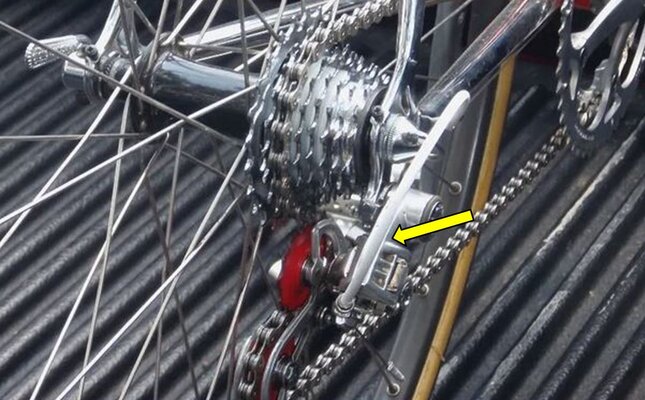
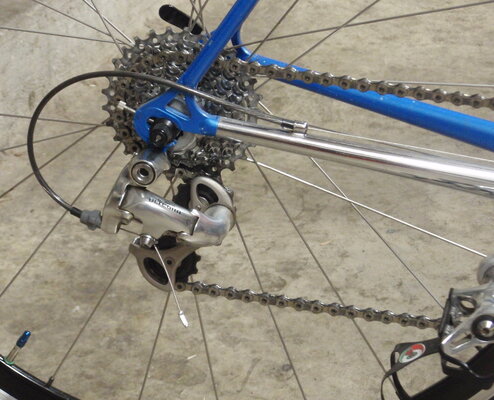
Perfect example, the weight cut-out on all Shimano rear derailleur bodies, which originated to shave a few grams over Campagnolo Record.
The RD body cut-out and stress riser follow all Shimano RD to date.
3OiOCmw.jpg

zJNXpFn.jpg
On higher-grade Shimano forgings, such as 600 and Ultegra above, the stress riser is no problem.
On lower grade metallurgy such as 300 and Exage, all Shimano RD bodies eventually crack here.

Note how Campy made this smooth, no stress riser (and beefier), also typical for SunTour and current SunXCD/Microshift.
Gdib7UDm.jpg


Adding a stem note, castings today are better than castings then, but e.g. Rivendell Bicycle Works only carries Nitto's forged stems.
 
Last edited:
Of peripheral interest, this was posted recently over on Bike Forums C&V from the July '73 issue of Bicycling magazine.
My natural inclination is to repair and reuse things but I can't get comfortable with this repair. Considering that there is a fair probability that metallurgy is a causal factor in the failure, modifying by hand what remains seems a risky proposition.
 
Back
Top