



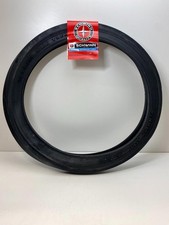


I always use new thornproof tubes- heavy but generally bulletproof. You can always patch a tube, but elderly tires can fail in a spectacular fashion. Keep them for display or sell them to someone who will.
I've got several boxes of Schwinn thorn resistant tubes here, I bought them up when the dealer closed up here in the early 80's. They had marked them down to $0.50 each so I bought them all, knowing I'd never use them up or in a timely manner I pulled each one out and bagged and shrink wrapped them so they don't age.
The problem though is that those were already too new to be really good tubes. They were already made in Taiwan by that point and they had shrunk in size as well.
I never liked what the thorn resistant tubes did to the ride or rolling resistance of a bike.
I've got two diamond frame cruisers here from the 80's, one a Giant, the other a Nishiki, which are both pretty much the same bike, one has heavy tubes, the other the original tubes from 1985. The tires are the same, Cheng Shin, raised center rib gumwall mtb tires in 2.125 size.
The both have black chrome steel rims. Both with Suntour coaster brake hubs and sealed bearing front hubs. The bike with the light tubes pedals easier and will coast forever, the one with the heavy tubes rides harder and feels sluggish and doesn't coast half as well. Both hubs are serviced the same and spin equally as free.
I talked to a guy once who worked in the tire industry, mainly with racing tires but I mentioned the effect I got with the heavy tubes, my thought would have been that the stiffer tube would roll better but the analogy he used was that a harder tire sometimes means there's a bit of rebound over obstacles which is felt as push back, and a heavier tube can create friction in the compression of the tire which absorbs energy. Thus when loaded it gives more resistance. In short you want the tire to conform and pass smoothly over an obstacle vs bounce over it.
When it comes to newer tubes leaking, its certainly gotten worse over the years. I can't even say when most of the tires I got from that cleanout were last pumped up but most were fully inflated and covered in years of dust.
A number of years ago I happened on a box of really old tire 'sealant' for bicycles It was nothing like slime, it smelled like coal tar and looked like coffee. I did some research and found nothing, but when I talked to a tire guy he said that coal tar was used in making old tires to keep the tires soft and UV resistant. He said adding it to rubber also formed a good bit of the carbon black in soft rubber. He then showed me how it can be used to soften or even re-vulcanize rubber with heat. He also said it was banned from use because the fumes were classified as a carcinogen. I figured the best way get rid of it was to use it. I added it to several tubes, all tubes that had high pressure leaks. They'd never go flat but they refused to stay fully inflated for more than a few days and no leaks showed up in a water tank.
I put 3 oz in each tube. They never leaked again. What was odd is that on the one bike, I replaced the rear tire, and I know I added a full tube of the stuff to that inner tube but I couldn't detect any sign of it once deflated other than the smell of coal tar when I let the air out.
What I did find was that if the tube was left flat, and let sit or rolled up, the insides will bond together and never come back apart.
I put that stuff in three bikes so far, the oldest has been inflated now for almost 20 years and its not lost any air. I put a half dozen tubes of it in a rotten wheel barrow tire that was leaking from dozens of cracks in the sidewall and it sealed that up and it too has never leaked since. The cracks even seem to have closed up or been sealed. The tubes of sealer are old enough that they came with a needle tool and five rubber bands for plugging the old single tube tires of the 1920's. What ever the stuff is it works well.


