When you click on links to various merchants on this site and make a purchase, this can result in this site earning a commission. Affiliate programs and affiliations include, but are not limited to, the eBay Partner Network.

Wartime Schwinn New World Bikes - We Know You Have Them - Tell Us About Them!!

#eBayPartner    Most Recent BUY IT NOW Items Listed on eBay
eBay Auction Picture
The victory bike, reconsidered:


"But the Victory Bike was not a victory for American bicycling; instead, it served to differentiate American adult bicycling for transportation from global cultures. In a multitude of ways, the Victory Bike program hobbled bicycle manufacturing and severely limited bicycle use rather than promoting it. Its name confuses matters, and tricks our understanding of the meaning of the bicycle’s past, present and future. This paper argues that we should reconsider the program as a defeat rather than a victory."
Interesting read, thanks, for posting that.
BB655BA4-396F-4EE0-B6C0-D76C543B4C6A.jpeg


ED79E233-95F3-46C9-82EF-D7A4C8E99899.jpeg
 
Hello Miq and others,

This is some more information that I have relocated in my records. It may be of some interest to those that collect WWII Schwinn '' Victory'' lightweight bicycles and are wondering about their wartime production.

According to Amendment 2 of the War Production Boards ( WPB ) Limitation Order L-52 regarding wartime bicycle production, dated Sept., 2, 1942 only Huffman and Columbia could with limitations continue to produce and distribute bicycles for the duration. However, upon special appeal other bicycle manufacturers may be authorized under specific limitations to sell remaining stocks of already produced bikes and produce limited quantities of new bicycles for limited periods of time.

In a copy of a declassified document from my records, dated 1946 National Archives, I found the following regarding Schwinn bicycles. Schwinn produced 13,000 bicycles in late 1942, 10,000 cycle trucks in 1943 and 10,000 cycle trucks in 1944. In addition they were able to distribute remaining stock on hand as of Sept., 1, 1942. Apparently, Schwinn submitted a special appeal to continue bike sales, which evidently was granted for at least 1 order of 13,000 new bikes in late 1942, production of which may have stretched into 1943. As of this time I have found no further documentation that further orders were granted.

As of Sept., 23, 1944 the Office of Price Administration ( OPA ) announced an industry wide restoration of bicycle production with some limitations. So as of this date all bicycle manufacturers could, with some limitations, restart new bicycle production.

I trust that this information will be helpful to those interested in wartime civilian bicycles.

Regards,
Bill Strong

This adds a definitive end date of Sept 1944
 
I think the Bike Battles article is generally good and generally correct, though perhaps erring a little on the negative side of the spectrum.

If the program was that bad, it seems to me companies like Westfield, Schwinn, and Cleveland Welding would have more quickly abandoned lightweight bikes after the war. But we know that Westfield and Cleveland Welding continued to make lightweights awhile longer, and Schwinn persisted for many years afterward. The Schwinn advertising takes a more youth-oriented tone about 1952 or so. You still see ads for adult-oriented, lightweights from Schwinn in the late 1940s and into the 1950s. Even some Clubman models were offered, though apparently not made in large numbers.

But I think the article is more right than not right. I think the best summation is in this paragraph:

While the general reception of the Victory Bike program was positive, not everyone was pleased. Jack Stinnett called it “a lot of balderdash” in his syndicated column. “America is a land of distances,” he argued: “Its problems are not at all those of cycling England, where distances are relatively short.” It was “a bit of fallacious reasoning . . . that the nation is going to take to bicycle wheels overnight.”

It was not that Americans could not or would not use bicycles, and it is not that the bicycles themselves were bad. Though they were spartan things, they were reasonably well-made and they did work. The problem is that distances traveled on a regular basis, even in the eastern and northern US (to say nothing of the west and the plains), are huge compared to England or France. The closest model was England, and the Victory Bikes are outgrowths of English designs from the period. American cities tended to be more sprawling and built around cars or public transportation. This is to say nothing of rural or suburban areas, which were more spread out. Even today, with ebikes and the like, most Americans still commute by car. Yes, more people use bikes, but the distances have not changed and so the cars remain the main way. I would not call the Victory Program a total failure, but it was perhaps wishful thinking and more an aspiration than a real contributor to the victory.
 
  • Like
Reactions: Miq
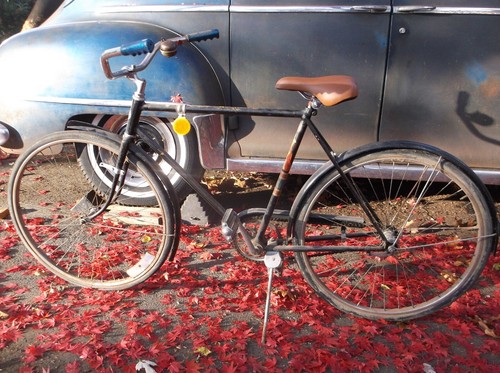
D98455 is a pre-war Schwinn, black paint, single speed coaster brake, silver wire braces, one piece crank. It is on eBay for sale (not mine). I don't know why the description and the photo have different numbers.


nw4.png


nw3.jpg


nw2.jpg


NW1.jpg
 
@RunGrampyRun the blue bike is the E serial bike of yours on the list, right? What is the maroon bike’s serial? Is it new to your collection? Nice looking paint!
 
Back
Top